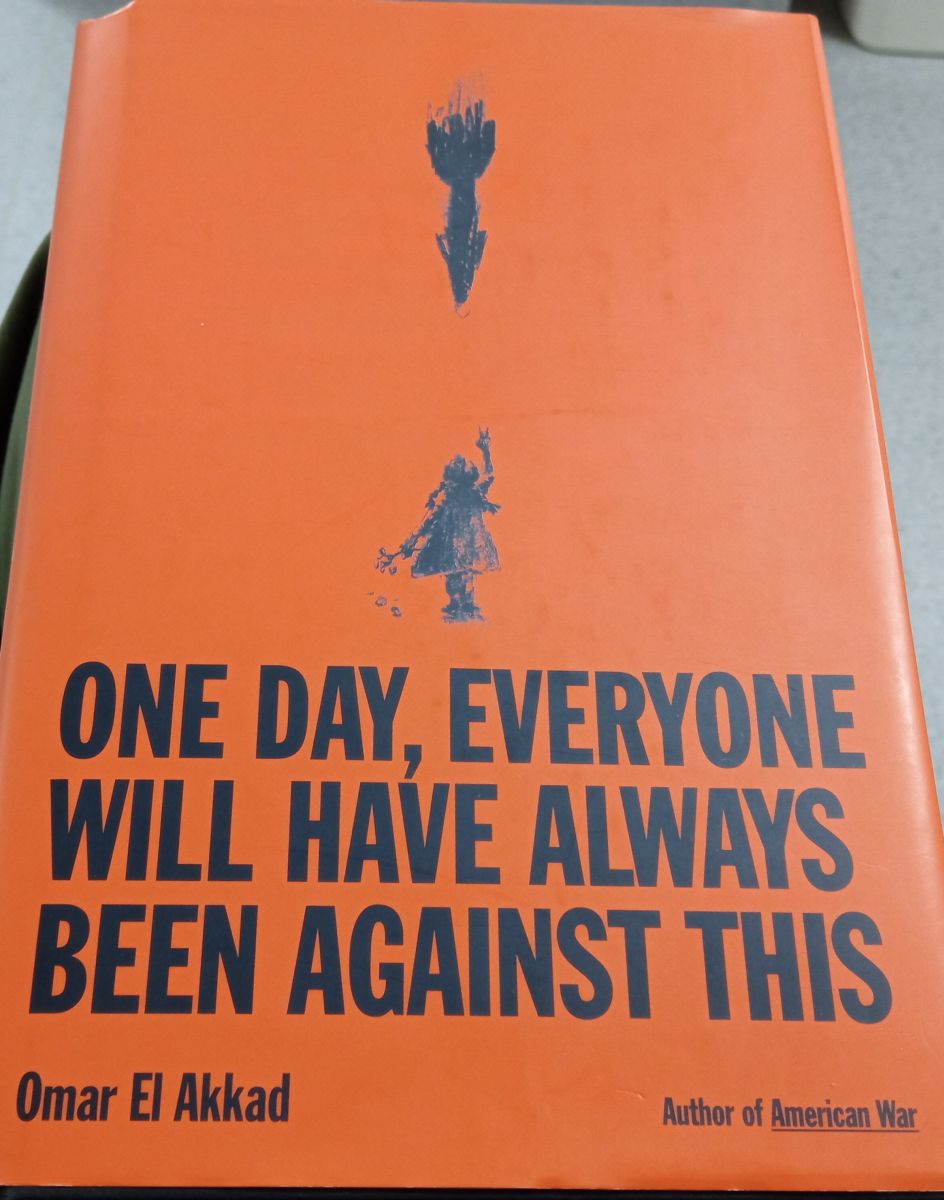
„On October 25, 2023, after just three weeks of the bombard-ment of Gaza, Omar El Akkad put out a tweet: “One day, when it’s safe, when there’s no personal downside to calling a thing what it is, when it’s too late to hold anyone accountable, everyone will have always been against this.“This tweet has been viewed more than 10 million times.“
„As an immigrant who came to the West, El Akkad believed that it promised freedom. A place of justice for all. But in the past twenty years, reporting on the War on Terror, Ferguson, climate change, Black Lives Matter protests, and more, and watching the unmitigated slaughter in Gaza, El Akkad has come to the conclusion that much of what the West promises is a lie. That there will always be entire groups of human beings it has never intended to treat as fully human-not just Arabs or Muslims or immigrants, but whoever falls outside the boundaries of privilege. One Day, Everyone Will Have Always Been Against This is a chronicle of that painful realization, a moral grappling with what it means, as a citizen of the U.S., as a father, to carve out some sense of possibility in a time of carnage.“
„This is El Akkad’s nonfiction debut, his most raw and vulnerable work to date, a heartsick breakup letter with the West. It is a brilliant articulation of the same breakup we are watching all over the United States, in family rooms, on college campuses, on city streets; the consequences of this rupture are just beginning. This book is for all the people who want something better than what the West has served up.“
„A soldier I met years ago, who made the study of industrial violence his hobby, once told me the first thing that kills when a bomb goes off isn’t shrapnel or fire. It’s the overpressure wave: air forced violently outward from the site of the blast. What you’re supposed to do, he said, is drop to the ground and cover your ears, breathe out, empty your lungs before the air collides with and flattens them.“ 3
„As the men carry the girl out of what used to be her home, she asks if they’re going to take her to the cemetery. One of the men says, Mashallah, mashallah.
In literal translation, the word means: What God wills. A closer approximation of meaning—of one meaning—is something like: What has happened is what God willed. But English, tasked with a word like this, turns stiff and monophonic, and Mashallah is orchestral. To any ear that grew up on this language, it is clear that what the man means when he says this word is something else entirely. Something instantly familiar to generations who’ve heard it spilling out of the mouths of beaming grandmothers at the end of piano recitals and graduation ceremonies and at the first sight of a newborn. Used this way, it finds its principal purpose, as an expression of joy. Look at this wonderful thing God has done.“ 4
„Language, too, forces the air from the lungs.
Beyond the high walls and barbed wire and checkpoints that pen this place, there is the empire. And the empire as well is cocooned inside its own fortress of language—a language through the prism of which buildings are never destroyed but rather spontaneously combust, in which blasts come and go like Chinooks over the mountain, and people are killed as though to be killed is the only natural and rightful ordering of their existence. As though living was the aberration. And this language might protect the empire’s most bloodthirsty fringe, but the fringe has no use for linguistic malpractice. It is instead the middle, the liberal, well-meaning, easily upset middle, that desperately needs the protection this kind of language provides. Because it is the middle of the empire that must look upon this and say: Yes, this is tragic, but necessary, because the alternative is barbarism. The alternative to the countless killed and maimed and orphaned and left without home without school without hospital and the screaming from under the rubble and the corpses disposed of by vultures and dogs and the days-old babies left to scream and starve, is barbarism.“ 5
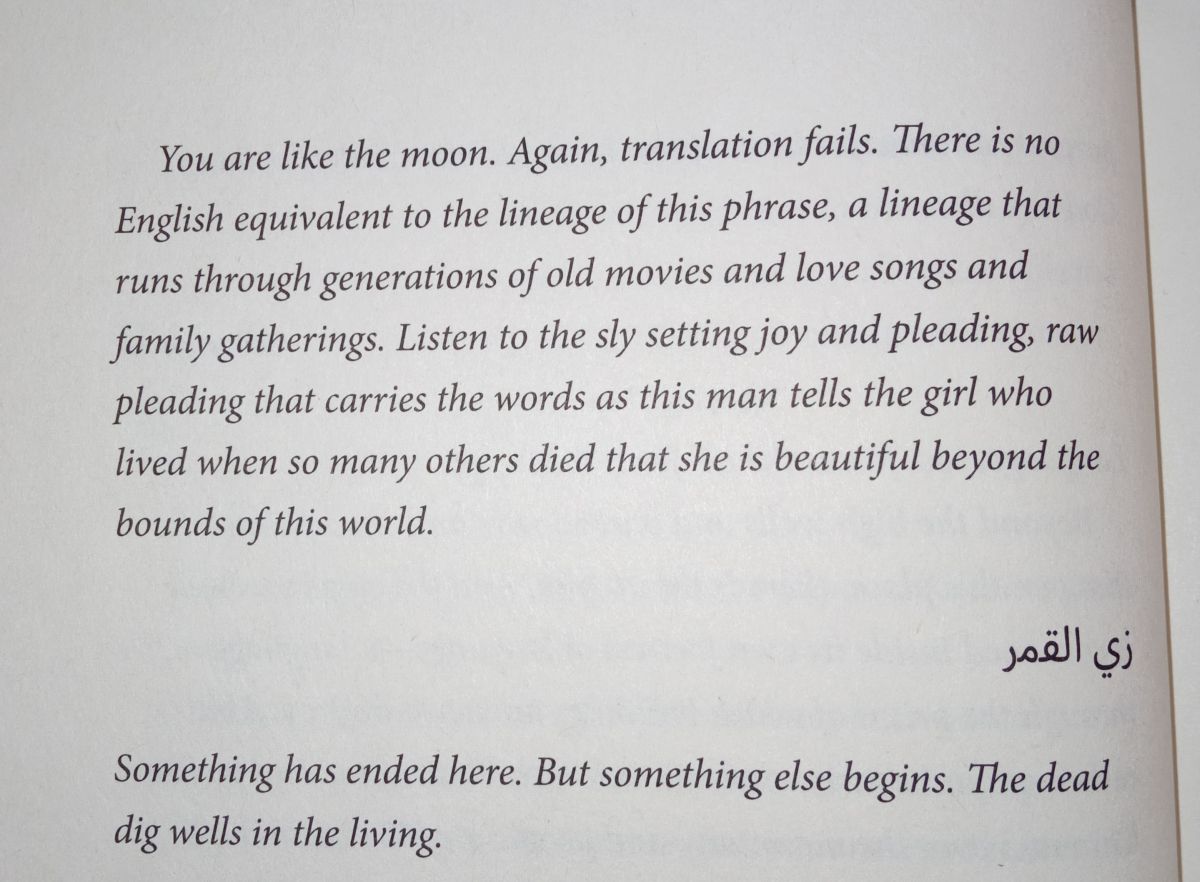
„The girl on the stretcher believes she has ended. A man says to her: Inti zay el amar.
You are like the moon. Again, translation fails. There is no English equivalent to the lineage of this phrase, a lineage that runs through generations of old movies and love songs and family gatherings. Listen to the sly setting joy and pleading, raw pleading that carries the words as this man tells the girl who lived when so many others died that she is beautiful beyond the bounds of this world.“ 5