
2025-06-23
„Question for the Lithuanians here:
Strangely, about a third of the Lithuanian taxi drivers I meet end up telling me how rich Lithuania is—GDP per capita, comparisons with Japan, Spain, etc. I don’t argue, but I find it curious how tuned in they are to national economics.
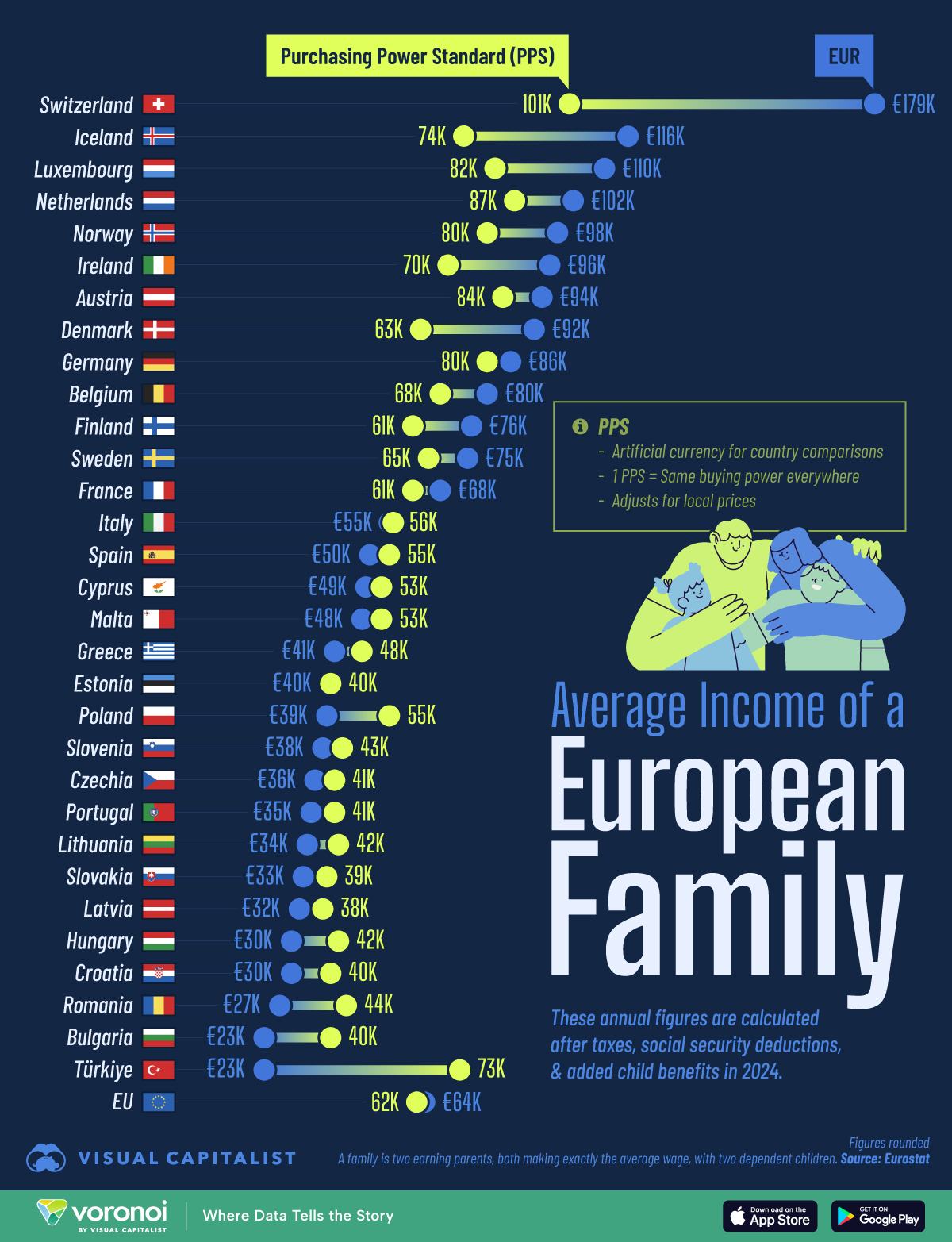
Then I see this on my Twitter feed (see image below):
So what’s the real situation for an average family in Vilnius or Kaunas? Not the media version—just the reality on the ground.“
https://www.facebook.com/groups/209733365824002/?multi_permalinks=3693215147475789
Komentarai
„Presuming they tend to compare to the other Baltic states, when they say Lithuania is rich. Not saying it’s poor neither but whatever that stats are, they’re always competing within the Baltic region
https://ec.europa.eu/eurostat/statistics-explained/index.php?title=Purchasing_power_parities_and_GDP_per_capita_-_preliminary_estimate“
„A general population with children live paycheck to paycheck“
+
„Ok, very straightforward, thanks for your reply. But then why do those taxi drivers try to convince me that Lithuania is pure rock and roll? That’s the part I find especially strange.
One thing that really surprises me is the price per square meter of top-tier real estate. In Madrid, for instance, Boadilla del Monte—a trendy area right now—goes for around €3,500/sqm, which is cheaper than Žvėrynas or Valakampiai. Rich people in Vilnius seem better off than their Spanish counterparts—or at least more willing to burn cash like maniacs. That must reflect something about how the rest of the population lives… or maybe not. I puzzles me…“
+
„Boadilla is not Madrid honestly speaking, and I haven’t seen anything near 3500 there, more like 5k++
Moreover , Žvėrynas is very close to the city center.
If we get back to 3500 per sqm then there are offers in Fabijoniskes and Jeruzale which are still much closer to the center than Boadilla del Monte to the center of Madrid“
+
„Boadilla del Monte is part of the Madrid metropolitan area and belongs to the Comunidad Autónoma. Your concept of “Madrid” is very airbnb touristy…
Some points:
1. Being close to the city center in Vilnius is just a psychological trick. There’s really nothing there. The Seimas is located in the center, and the area is completely empty after 17:00, even on weekdays.
2. Boadilla del Monte is about 20 km from Barrio de Salamanca, for example. Valakampiai is 6 km from the Castle. The population of the Madrid metropolitan area is around 4 million; in Vilnius, it’s about 600,000. The city is almost 7 times bigger, distances should be considered accordingly
3. I just checked Idealista, and it’s relatively easy to find super-premium properties at €4,000 per sqm. This one, for instance, is even lower—€3,400 per sqm:
https://www.idealista.com/en/inmueble/107680388/
4. If you compare the income level in Boadilla with that of premium areas in Vilnius, Boadilla’s is higher—or even much higher (to make it simple, for example, in Madrid there are 5 football teams that compete in LaLiga; that is some 120-150 dudes earning a minimum of 500k per year, at least half of them earning at least 5 mil per year; for some reason, many footballers are moving to Boadilla; La Finca and Moraleja are not that popular any longer). Yet people in Vilnius are willing to pay more per sqm… pure extravagance, I guess.
5. Even in Conde de Orgaz (that is Madrid for you 😃) you can find houses with a pool at 4k sqm, even if the average is 6k
6. Don’t waste too much time arguing 😃 I’m from Spain and I spend time in Madrid from time to time…“
+
„Madrid Metropolitan Area is a broader region that encompasses the city of Madrid and its surrounding municipalities, Madrid refers specifically to the city itself…
With this logic, we have to consider not Žvėrynas which is a central district of Vilnius City, but look at the Vilnius urban area which includes for example part of Trakai district. You can not compare Žvėrynas to Boadila, it like comparing an ant to a gorilla.“
+
„Conde de Orgaz then? 4k sqm, with a pool. That is Madrid proper…
Or perhaps we should compare Zaragoza to Vilnius 😃 Similar ants?“
+
„I don’t know which website you are using, I am looking at idealista. Most prices in that area is 6-8k sqm“
+
„I have already told you i am looking at idealista…
Without going to crazy, because you are just bitching… 😃 or just checking the idealista version for calamares.
4700: https://www.idealista.com/en/inmueble/105891810/
4800: https://www.idealista.com/en/inmueble/101344227/
4800: https://www.idealista.com/en/inmueble/102729947/
Your oligarchs pay more—much more—for their housing than mine. They spend more in cars than Nordic oligarchs, etc. I’m sure you have plenty of reasons to justify it, but that’s not what I’m discussing… all started with some taxi drivers stating that Lithuania, blahblahblah…“
+
„phrases like “paycheck to paycheck” mean pretty much nothing. One can have some money left before the next paycheck, but it in saving and say technically correctly that they are living paycheck to paycheck becayse they have “nothing” at the end“
+
„That expression refers to mandatory expenses, not to the idea that you can’t save because you spend your entire €20k salary on LV bags…“
„also, the salaries are much different outside of Vilnius and Kaunas bubbles. And there is limited supply of apartments or houses so the prices are hiked up.“
+
„This is another thing that I find weird… housing scarcity…
Let’s see:
1. In the good ol’ times, where did people use to live? In the bushes? Because as per official stats, the population in Vilnius has been practically flat for a long time (in the last 20 years or so); now everybody needs to own 3-4 flats in the hood to feel like a complete person? Very respectable in any case, but that leads to many other questions
2. Population at national level has been decreasing steadily for the last 20 years as well so… perhaps scarcity is mainly artificial? You know, cartelization of land ownership and politicians understanding well who pays for their summer houses abroad, for example“
+
„I think, it’s also related to job opportunities and students arriving yo cities. During soviet times you would get a job somewhere, which is provided by state and be happy with it. After Soviet times, people have to find a housing and a job. Depending on one’s skills there can be more opportunities in cities with higher salaries“
+
„population in Vilnius was growing steadily in the past 20 years. No idea where your numbers are coming from 🤷♀️ hence the increased housing need. And just a small remark – your tone is a bit agressive, not sure why?“
+
„Where are yours?
https://en.wikipedia.org/wiki/Demographics_of_Vilnius“
„fun fact: in the prestigious town of Salou near Tarragona there are particularly rich protected areas on the coast, where property can only be purchased on recommendation and upon presentation of the amount in the accounts, a huge number of apartments there owned by Lithuanians.“
„you see, our taxes are high on workers and low on owners. So if you own a business, it’s not hard to reduce your marginal tax rate to ~15%. As taxi drivers work as “owners”, they go into that low rate as well.“
„They are probably referring to the fact that Lithuania is 33rd in the world in terms of GPD (PPP) per capita, according to International Monetary Fund’s projection for 2025 (source: https://en.wikipedia.org/wiki/List_of_countries_by_GDP_(PPP)_per_capita#Table)
Most of the economists, the media, and scientists use it as a base to argue that Lithuania is a rich country.
Additional arguments to support this is the rapid transformation of the economy and growth since regaining independence in 1990, rapid growth post-2020, as well as post 2022.
Regarding average net salary in PPP terms, I’d rather use this table: https://en.wikipedia.org/wiki/List_of_European_countries_by_average_wage#Net_average_monthly_salary_(adjusted_for_living_costs_in_PPP)“
„There is quite a lot of wealth inequality in Lithuania. There are definitely enough rich people about, and plenty of signs of gentrification and investment going on. But it’s also not hard to find poverty. You can see quite a big difference between the regions in some of these maps. https://ec.europa.eu/eurostat/statistics-explained/index.php?oldid=676599“
„The problem is that our middle class is too small. We have very rich (and not a small amount as it could be seen) and very poor families. I have a babysitters agency so I work with both. Compared to 10 years ago Lithuanian people are getting richer on both sides.“
+
„What you mention is also very strange. I get the impression that the rich—though not that many—live like pure oligarchs compared to the rest of the population. The cars, the houses… things you’d never see in Scandinavian countries, for example. And yet, the Gini coefficient claims Lithuania is quite an egalitarian society.
A Gini of 36.7… and more Bentleys and Rolls in Vilnius than practically in all Sweden. Either Gini lies or this is a new paradigm…“
+
„the cars are bought by the company to reduce tax. Lithuania is super friendly for company owners when it comes to taxes. So the difference comes from the % of taxes paid on the income, not the income itself that much.“
+
„My greatest hope is that the ‘middle class’ will become truly ‘middle class’ and not a group of average poor people. As I said, the situation is improving.“
„“The cars, the houses… things you’d NEVER see in Scandinavian countries”…. Naaawww… another one, idealizing Scandinavia… ❤️ I’ve lived in Norway and Denmark for the past 10 years, working solely for local banks and fintechs. If I were you, I’d use that “never” very sparingly when talking about Scandinavia, their egalitarianism and Jantoven 😉“
+
„I lived in Sweden—2 years in Gothenburg, 8 in Stockholm. In Stockholm, I stayed in Vasastan and Kungsholmen and at worked at a law firm by Sturegatan. The best car I saw in those 8 years? A Porsche 997 Turbo owned by my then-girlfriend 😃—a gift from her forest-owner dad when she started working at the Ministry of Foreign Affairs.
In general, people were quite content with average BMWs and the occasional Saab Turbo Cabriolet for the summer.
Swedes with money usually keep a low profile at home. Do some go a bit wild on holidays in the south of France or Spain? Sure—why not? But back home, things stay pretty understated.
I’m sure you know Denmark and Norway well, though… 😘 in Sweden it is called Jantelagen 😎“
„“Exactly the average wage” that will be misleading. They should use median, and rhey might’ve, but didn’t say that.
Especially in Lithuania there is a huge difference between the two.
If income after taxes etc is 42k it definitely feels like mean and not median. 1.75k€ per person each month. Thats not real. Latest figures for “average” are about 1400€ and I don’t think there’s much benefits around to raise it even higher.
And I remember seeing much lower as medians – which is the meaningful one. So I’m slightly questioning the data.“
+
„And yes, this is BS. I checked Finland, there median income BEFORE TAXES was 3564. This chart claims income AFTER TAXES would be 3167 euros.
Sure, you get benefits for kids etc but I still don’t think it changes things when taxes etc from that would drop it down quite a bit.
So, once again, would need to see the actual data and methods and explanation for this to mean anything.“
+
„you are looking to PPS (yellow line), those are not real money.
Real money are in the blue line.
Please also take note that is for the family so you need to divide that by two to see individual “income” and PPS: 17000 a year for individual seems to be about right for Lithuania taking into account in statistics Vilnius and Kaunas salaries are mixed with other half of the country.“
„Lithuanians for the most part don’t get into debt like the rest of the world. Look this up, compared with most nations Lithuania has a very low household debt to national GDP.
This is what they may be referring to. I know that my wife’s family saved up money to buy a car, vacation home, etc.. They refuse to take loans and get into debt. They all have very nice lives and they don’t seem to be missing out on much.
I understand debt and how it is not necessarily a bad thing, I don’t need a lesson on that. I’m just trying to provide some context. This is what they may be referring to.
Lithuanians are also very competitive and capitalistic. They save and are also extremely resourceful. If there is a way to make money, they find it.“
„1. Vilnius income level is considerably higher than average:
in accordance with 2023 data it was 99 % to EU27 average comparing to 67% in country overall. Hence the Gini index.
2. People who saves pennies usually take a bus, not a taxi.
3. Majority taxi drivers in Vilnius are economical immigrants. They seen way worse in their lives. Local ones don’t come from the money exactly as well.
4. Lithuanian average is still bellow Eu one. But looking from time perspective tendencies are not that bad: average net income increase in Lithuania since 2017 was 3 times higher than average increase in Eu.
5. It is quite common nowadays for many companies to provide taxi benefits for their employees as a part of social benefit package.
It is probably five times cheaper for them to provide 100 eur in taxi services benefit than to increase net salary by 100 eur.
P.s. I dont have a study about it but somehow many Lithuanians, especially guys, REALLY love cars. I have a feeling way more than average Scandinavian does: they can talk about them for hours, they care about them, they make car purchase parties (sometimes with a real priest and holy water), they improve them with different gadgets, they can easily spend few hours cleaning them, you know, just as a hobby, etc.
In general (and thats just my gut feeling) average Lithuanian male would most probably choose to use extra 100 eur a month on a better/more expensive car (leasing) vs using those money for better/more expensive holidays or clothes.
Hence the ferraries and bentleys when they can afford one. 🙂
Dubai of the North. 🙂
Not having Scandinavian 100 percent car tax also helps. 🙂
Maybe, because we are just a generation away from russian ladas and moskviches. 🙂
I think this changing a lot with Z generation.“
+
„1. The Gini coefficient measures income or wealth inequality within a population. Whether income in Lithuania is 99% or 29% of the EU average doesn’t really affect the Gini.
2. Scandinavian 100% car tax? 😮 No idea how DK or NO tax their cars, but Sweden does not have a 100% car tax. Hmmmm… perhaps if you define “car tax”…“
+
„At least in Denmark Vehicle tax is very high, check the picture.
Maybe Sweden does not have such Draconian laws, but there is for sure some yearly car tax in Sweden as well, which administered by Transport Authority.
As for the Gini.
If Vilnius income is Eu average, and all the country (including Vilnius) is just 70 percent of Eu, that means that Vilnius income is approx 40-50 percent higher than the rest of the country.
Hence the high Gini percentage.
It is not that 5 percent are very rich and 95 are very poor.
That was my point.“
+
„That pic is just madness. In SE they tax high emission cars, but unless you are driving an old tank, the amount is relatively low. For example, a Tiguan TDI in Sweden would come along with an annual payment of some 500-600e for the first 3 years. Afterwards it is just a bit higher than in LT (there is a calculator for that; in Sweden there is a calculator for everything 😃)
I agree to some extent. Regional disparity in Lithuania is massive—some regions have a GDP per capita nearly three times lower than that of Vilnius. But that doesn’t mean income distribution within Vilnius is equal. It’s a “technically” interesting debate, but one that requires a lot of data which may not be readily available. In any case, the initial argument (see chart) was about Lithuania as a whole, not only Vilnius. Currently we might be discussing something else 😃 I do not know…“
„starting at 33k… no way. For both LT and SVK most families have like 24k to 30k after taxes if two are working, if you omit the tech bros, managers, business owners with employees etc… But then again, the average is a numbers game and therefore not telling much.“
„GDP per capita can be
NOMINAL
PPP (purchasing power parity)
With nominal – we still have a lot to grow
PPP – quite decent already“
„Here are the numbers: wages brutto (netto about 1.6x less, 3000€ brutto is about 1800€ netto)“
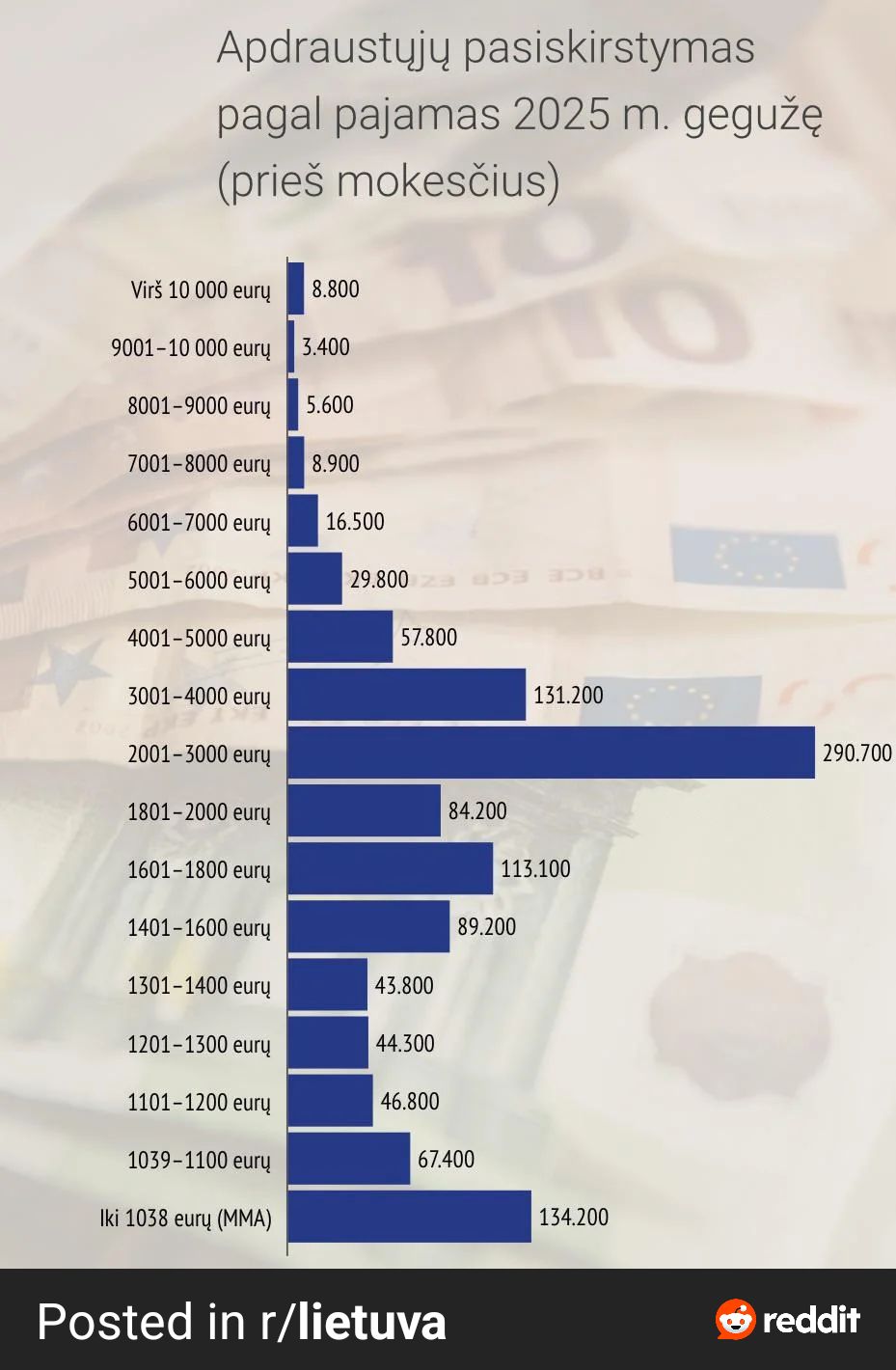
„Alright. I have found the answer. I though Lithuanian’s Gini was reasonably low, but it isn’t. It is the second “worst” in Europe.
The if I have 2 chicken and you have 0 chicken, statistically we have 1 chicken each 😃
Thanks for your comments.
https://statice.is/publications/news-archive/quality-of-life/gini-coefficient-preliminary-figures-for-2022/“